The problem
Technology shifts income toward owners.
As machines do more of the work, market income flows to those who own them. Most people live on wages alone, so demand lags and wealth concentrates.
Technology makes capital ever more productive. Louis Kelso’s answer was not redistribution, but broader ownership.
1956
Kelso designs the first ESOP
1974
ESOPs written into federal law
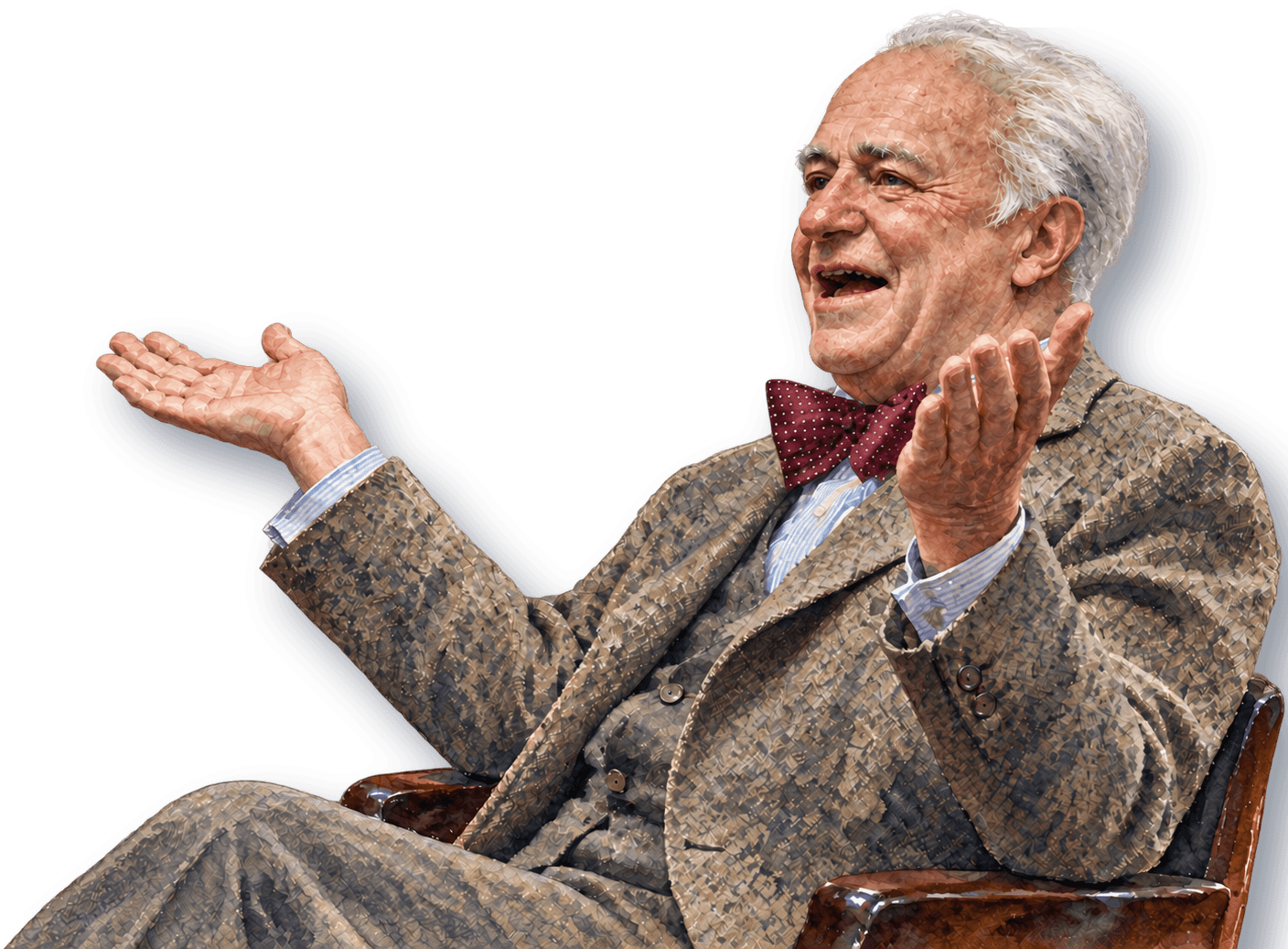
“If capital ownership is good for the rich, it is a thousand times better for the middle class and the poor.”
Louis O. Kelso, 1913–1991
The idea in brief
About the Kelso Paradigm
The problem
As machines do more of the work, market income flows to those who own them. Most people live on wages alone, so demand lags and wealth concentrates.
The insight
Labor and capital both produce wealth. Kelso called this binary economics: a market economy is stable and just only when both are broadly owned.
The tools
The ESOP, CSOP and GSOP let people without savings buy capital and pay for it out of its own future earnings.
Why Kelso, why now
Kelso spent his life studying what happens when machines grow more productive than people. As software and artificial intelligence take on more of the world’s work, the question he first asked in 1931 has never been more urgent.
Why Kelso matters for AI
Americans are a nation of industrial sharecroppers who work for somebody else and have no other source of income.
Louis O. Kelso, as quoted by Mike Wallace on CBS 60 Minutes, 1975
The library is open
Kelso’s major books, published electronically for non-commercial, educational use.
1958
The Capitalist Manifesto
Kelso & Adler
The first public statement of Kelso’s theory: a blueprint for a capitalism redeemed of its historical flaws.
Download PDF
1961
The New Capitalists
Kelso & Adler
A proposal to free economic growth from the slavery of savings, with the financial tools to do it.
Download PDF
1967
Two-Factor Theory
Kelso & Hetter
The Economics of Reality: how to turn workers into capitalists on borrowed money.
Download PDF
1986 · 1991
Democracy and Economic Power
Kelso & Hetter Kelso
Extending the ESOP revolution through binary economics. Kelso’s final and fullest statement.
Get the ebook on Amazon

A message from our President
“Louis was not trying to redistribute wealth. He was trying to change who owns the means of producing it.”
John Schooler Jones, President, who worked with Louis Kelso in the 1970s
Important dates
Full timeline
1956
Kelso invents the ESOP so Peninsula Newspapers employees in Palo Alto can buy their company.
1958
Central Valley farmers become owners of Valley Nitrogen Producers. The Capitalist Manifesto is published.
1963
Patricia Hetter meets Kelso and becomes his lifelong collaborator and co-author.
1967
Random House publishes Kelso and Hetter’s book, later retitled Two-Factor Theory.
1973
Kelso meets Senator Russell B. Long. Congress defines the ESOP for the first time.
1974
ERISA writes the ESOP into the Internal Revenue Code.
1975
Kelso and the ESOP are featured on CBS 60 Minutes with Mike Wallace.
1990
Bill Moyers interviews Kelso on PBS’s A World of Ideas.


The people
Louis Kelso began asking why market economies boom and collapse in 1931, at seventeen, in the depths of the Great Depression. A San Francisco lawyer and merchant banker, he designed the first ESOP in 1956.
In 1963 he met Patricia Hetter, and from then on the work was theirs together. They wrote Two-Factor Theory (1967) and Democracy and Economic Power (1986), coined the term “universal capitalism,” and helped build Kelso & Company. After Louis died in 1991, Patricia led the Kelso Institute and saw their ideas published in Russian and Chinese.
As Louis put it in 1988: “first I alone, and then … Patricia and I.”
Meet Louis and Patricia